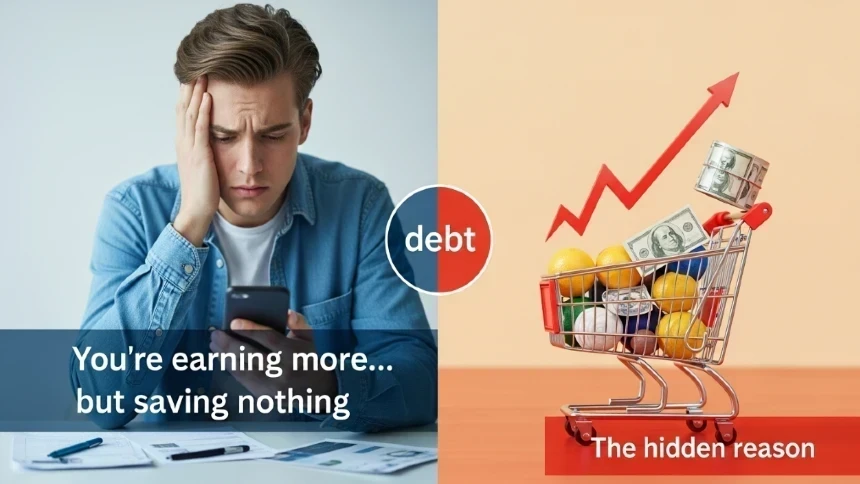


The Hidden Reason You’re Earning More But Saving Nothing
You worked hard. You got the raise. Maybe even a better job. On paper, everything improved — your income, your career, your opportunities.
But then something strange happened: your bank account didn’t.
If you’re wondering why you’re earning more but saving nothing, you’re not alone. This is one of the most searched and frustrating personal finance problems in the United States today — and it’s getting worse as incomes rise.
At first, it doesn’t make sense. More money should create more savings. However, the reality is far more subtle — and far more damaging.
Because the truth is simple:
Your income increased… but your lifestyle increased even faster.
The Silent Trap Behind Your Financial Stress: Lifestyle Inflation
The real reason you’re not saving money isn’t obvious spending — it’s gradual lifestyle inflation.
Lifestyle inflation is the invisible financial force that increases your cost of living every time your income rises.
Instead of building wealth, your money silently upgrades your life:
A slightly better phone
More frequent food delivery
Subscriptions you forgot you even had
“Justified” lifestyle upgrades that feel normal
None of these feel like financial mistakes. That’s exactly why they are so dangerous.
Over time, your “new normal” becomes just as expensive as your old financial struggle — only more comfortable.
Many people only realize this when they start tracking expenses using tools like the <strong>YNAB Budgeting App</strong>, which reveals where money is actually going instead of where you think it is going.
Why Your Brain Works Against Your Savings (The Psychology Explained)
Here’s something most people don’t realize:
Your brain is wired to reward earning more — not saving more.
In other words, when your income increases, your brain doesn’t prioritize financial security. It prioritizes immediate reward.
It starts asking one simple question:
“How can I enjoy this money right now?”
This is not a lack of discipline. It’s human psychology.
When you make more money, your internal system doesn’t say “secure the future.”
It says:
“You deserve something better now.”
“You’ve worked hard for this.”
“It won’t hurt to upgrade a little.”
Individually, these thoughts feel harmless. Together, they completely reshape your financial behavior.
And the most dangerous part?
It doesn’t feel like overspending.
It feels like progress.
The Dopamine Loop That Keeps You Spending
Every purchase triggers a small dopamine response — a quick emotional reward.
It creates feelings of:
pleasure
improvement
identity upgrade
But saving money works differently.
Saving is:
slow
invisible
emotionally unrewarding in the short term
So your brain naturally prefers spending over saving.
This is why even highly intelligent, disciplined people fall into the same pattern:
They don’t lose control at once.
They lose control gradually — through small, rationalized decisions.
Over time, those decisions compound into financial stagnation.
Many people break this cycle using systems like an <strong>Automatic Savings Plan</strong>, which removes emotional decision-making from the equation.
The Invisible Story Your Brain Keeps Telling You
As income grows, your internal narrative changes without you noticing.
You start thinking:
“I can afford a better lifestyle now.”
“I’ve earned this upgrade.”
“It’s just a small purchase.”
None of these thoughts are extreme.
But together, they quietly reprogram your financial identity.
You stop thinking like someone building wealth.
And start thinking like someone maintaining comfort.
That shift is the real trap.
Because you no longer feel like you’re overspending.
You feel like you’re improving your life.
The Silent Financial Imbalance Most People Never Fix
The core issue is not discipline.
It’s design.
Your brain is optimized for:
immediate comfort
emotional reward
short-term satisfaction
It is NOT optimized for:
delayed gratification
long-term wealth building
So unless you consciously override this system, every income increase will naturally transform into lifestyle expansion instead of savings growth.
That is why earning more rarely fixes financial stress.
It simply raises the baseline of what feels “normal.”
The Real Problem: You’re Saving What’s Left (Not What Matters)
This is where everything breaks.
Most people try to save what’s left after spending.
But in reality, there is rarely anything left.
Because spending expands to fill income.
The shift that changes everything is simple but powerful:
Financially stable people don’t save what’s left.
They spend what’s left after saving.
This single shift changes everything:
Income arrives
Savings are automatically removed first
Lifestyle adjusts to what remains
Simple. Structured. Effective.
Tools like a <strong>High-Yield Savings Account</strong> amplify this strategy by making savings grow passively while remaining accessible.
How to Finally Start Saving Money (Even Without Earning More)
The solution is not more income — it is better structure.
Here is what actually works:
1. Track Everything for Awareness
You cannot improve what you don’t see. Track all expenses for at least 7 days.
2. Pay Yourself First
Save a fixed percentage immediately after income arrives.
3. Eliminate Invisible Spending Leaks
Subscriptions, micro-purchases, and convenience spending accumulate silently.
4. Automate Your Savings
Remove emotional decision-making entirely.
5. Define a Clear Financial Purpose
Money without purpose is always spent.
When your money has direction, your behavior changes automatically.
The Emotional Truth Behind Money Struggles
At some point, this is no longer about money.
It becomes about control.
About stability.
About peace of mind.
Because what you truly want is not just a higher income.
You want progress that you can actually feel.
You want security that lasts.
You want freedom from constant financial pressure.
And that starts with one decision:
Change the system — not just the income.
Final Insight
If you’re earning more but still not saving, the problem is not your income.
It’s your financial structure.
And the moment you change that structure, everything changes with it.
Because wealth is not built by how much you earn.
It is built by how much you keep.
FAQ — Why You’re Earning More But Saving Nothing
Why am I earning more but still not saving money?
Because your expenses are increasing at the same speed as your income. This is known as lifestyle inflation, where better earnings quietly lead to higher spending habits, subscriptions, and upgrades that absorb all extra income without you noticing.
What is lifestyle inflation and why does it happen?
Lifestyle inflation happens when your standard of living rises every time your income increases. It happens naturally because the brain associates higher income with reward, leading to more spending on comfort, convenience, and status without intentional financial control.
How do people fall into the trap of earning more but staying broke?
Most people increase spending immediately after getting a raise instead of directing extra income toward savings. Without a clear budget or automatic savings system, money gets absorbed into daily life expenses, leaving no real financial growth.
Can you save money even if your expenses are high?
Yes, but only if saving becomes a priority instead of an afterthought. The most effective method is to “pay yourself first,” meaning you set aside savings immediately when income arrives before paying bills or spending on lifestyle upgrades.
What is the biggest hidden reason people don’t save money?
The biggest hidden reason is unconscious spending. Small, repeated expenses like subscriptions, delivery services, and lifestyle upgrades slowly increase your monthly cost of living until your income feels “not enough” again.
How can I start saving money immediately?
Start by tracking all expenses, cutting unnecessary spending, and automating savings. Even a small fixed percentage saved at the beginning of the month creates consistency and breaks the cycle of spending everything you earn.
Is earning more money enough to become financially stable?
No. Financial stability depends more on money habits than income level. Without budgeting and saving discipline, higher income usually leads to higher expenses instead of wealth accumulation.