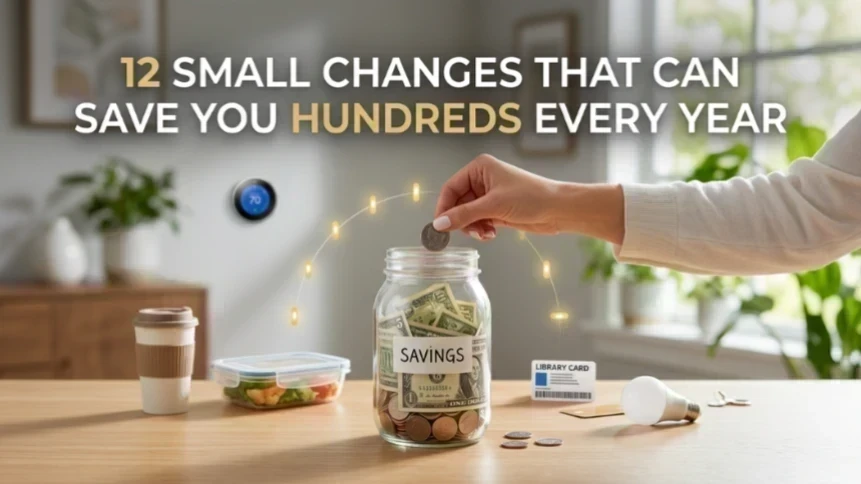









How to save $100 a month sounds like a simple money goal until life gets busy, expensive, and emotionally exhausting. You may already be working hard, paying the bills, handling responsibilities, and trying to keep everything moving. The last thing you need is another complicated financial system telling you that you are not doing enough.
But here is the part that often gets missed: saving $100 a month does not have to come from one dramatic sacrifice. It can come from several small decisions that quietly change where your money goes.
And when you are mentally overloaded, that distinction matters. You can be functioning, working, answering messages, taking care of everyone else, and still feel like something is off. That silent burnout can spill into your finances through convenience spending, forgotten subscriptions, emotional purchases, takeout, and the simple desire to make one part of your day easier.
The goal is not to make your life smaller. The goal is to create $100 of breathing room without making you feel deprived.
How to Save $100 a Month Without Making Life Miserable
The easiest way to save $100 a month is to stop looking for one huge expense to eliminate and instead find several small leaks that barely feel important on their own.
Think about it this way. Saving $25 on groceries, $20 on subscriptions and recurring charges, $30 on convenience spending, and $25 through a few intentional purchases gets you to $100. No dramatic lifestyle overhaul required.
That approach is especially useful when your mental energy is already low. A complicated budget can become another task you avoid. A handful of simple decisions can be much easier to maintain.
Start with expenses you barely notice
Open your bank and credit card statements and look at the last 30 days. Do not judge yourself while you do it. Just look.
Search for charges that made sense when you signed up but no longer feel valuable. Maybe it is an app you rarely use, a membership you forgot about, a delivery fee that keeps appearing, or a recurring service that quietly increased in price.
For some people, this first review is surprisingly emotional. The problem is not always that they spend recklessly. They are simply tired. When you are living on autopilot, small financial decisions can happen without much thought.
A simple YNAB budgeting system or another budgeting app can make recurring spending easier to see because the goal is awareness, not punishment. You do not need to track every penny forever. Even one honest review can reveal patterns you had stopped noticing.
Save $100 a Month by Fixing the Silent Spending Leaks
The most powerful changes are often the ones that do not feel dramatic. A $7 subscription, a $12 service, a few delivery fees, and several impulse purchases can quietly become much more than expected.
This is why saving money sometimes feels confusing. You look at one purchase and think, “That is not the problem.” And individually, it may not be. The problem is the pattern.
Find your convenience tax
Convenience is not bad. In fact, sometimes paying for convenience is exactly what you need. The issue appears when convenience becomes the default rather than an intentional choice.
Consider how often you pay extra because you are exhausted. A delivery order after a long day. A coffee because you left home without breakfast. A last-minute grocery run because there is nothing planned for dinner. A ride because you do not want to deal with one more task.
You do not need to eliminate these things. Instead, choose one category and reduce it slightly.
For example, if you spend $60 a month on delivery fees and convenience charges, cutting that by half could free up around $30. That is already 30 percent of your $100 goal.
Having simple tools available can also reduce the temptation to make expensive convenience decisions when you are tired. A Hamilton Beach programmable slow cooker, for example, can make it easier to have a basic meal waiting at home on demanding days. The point is not the appliance itself. The point is creating an environment where the cheaper choice is also the easier choice.
Use the 24-hour pause
Another small change can protect your money from emotional spending: wait 24 hours before buying nonessential items that suddenly feel urgent.
This works because emotional desire often has a short life span. What feels like something you absolutely need at 10 p.m. may feel completely unnecessary the next afternoon.
In other words, you are not telling yourself “never.” You are simply giving your future self a vote.
How to Save $100 a Month on Food Without Feeling Deprived
Food is one of the easiest places to find savings, but it is also one of the easiest places to become overly restrictive. That is why the goal should not be eating as cheaply as possible. The goal is reducing waste and making fewer expensive decisions when you are exhausted.
Build a small repeatable grocery list
You do not need a completely different meal plan every week. In fact, repeating a few meals can make life easier.
Create a short list of foods your household actually eats. Choose a few breakfasts, lunches, dinners, snacks, and flexible ingredients. Then shop around those foods instead of wandering through the store hoping inspiration appears.
A simple grocery routine can reduce impulse purchases while also reducing the mental load of constantly deciding what to eat.
For people who cook regularly, a Victorinox Fibrox Pro Chef's Knife can be a practical kitchen tool because a reliable knife makes basic meal preparation faster and more comfortable. Again, the financial principle is bigger than the product: make the behavior you want to repeat easier.
Use what you already have
Before your next grocery trip, check your refrigerator, freezer, and pantry. You may discover ingredients that can become an entire meal.
Try a simple “use it first” night once a week. Leftover vegetables can become an omelet. Rice can become a quick bowl. Pasta can absorb whatever needs to be used. Frozen ingredients can save you from an unnecessary takeout order.
If this saves even $10 to $15 per week, you could potentially create $40 to $60 of monthly breathing room.
Reduce One Recurring Expense Instead of Cutting Everything
When people decide they need to save money, they often attack everything at once. They cancel every subscription, stop eating out, eliminate entertainment, and promise themselves they will never spend unnecessarily again.
That can work for a short period. But if the plan feels miserable, it becomes difficult to sustain.
A better approach is to ask one uncomfortable but useful question: Which expense can I reduce without making my everyday life noticeably worse?
Look at bills you accepted as permanent
Review your phone plan, internet bill, insurance, memberships, streaming services, and other recurring charges. Prices and needs change over time, but people often keep paying the same amount simply because changing it feels like work.
You may discover that you are paying for a faster internet tier you do not need, multiple streaming platforms you barely use, or a membership that made sense six months ago but no longer fits your life.
Even one $20 monthly reduction equals $240 a year.
Make your home support your financial goals
Your environment influences your spending more than you may realize. If the easiest option is always ordering food, browsing shopping apps, or buying something because it is within reach, your environment is quietly shaping your financial behavior.
Simple changes can help. Remove shopping apps from your home screen. Unsubscribe from promotional emails. Keep easy meals available. Put a water bottle near your desk. Create a small comfort routine that does not require spending money.
A Simple Modern insulated tumbler, for instance, can become part of a low-cost daily routine if it helps you carry coffee or water from home instead of repeatedly buying drinks while you are out. Small systems matter because they remove decisions.
The Mental Fatigue Behind Overspending
There is a deeper reason saving $100 a month can feel harder than the math suggests: mental fatigue changes the way we make everyday decisions.
When your brain is overloaded, you naturally look for shortcuts. You choose what is fastest. You postpone decisions. You spend a little to make an annoying problem disappear.
That does not mean you are irresponsible. It means your financial habits are connected to your emotional energy.
When you are functioning but not okay
You can be successful on paper and still feel financially scattered. You can earn a reasonable income, pay your bills, and keep your responsibilities under control while secretly feeling exhausted by every decision.
That feeling matters because money management requires attention. When attention is depleted, small problems remain invisible until they become expensive.
This is why a financial reset can be more useful than another complicated budget. Give yourself 15 minutes. Look at your recent spending. Identify one recurring leak, one convenience expense, and one purchase you could postpone.
Then stop.
You do not need to solve your entire financial life in one sitting.
Turn $100 Into a Monthly System
Once you find your $100, make the savings automatic whenever possible. Otherwise, there is a good chance the money will simply get absorbed into the next month.
Try a simple $25-per-week structure
Instead of thinking, “I have to save $100 this month,” think about finding approximately $25 each week.
$10 from groceries or food waste
$5 from subscriptions or recurring charges
$5 from convenience spending
$5 from delaying an unnecessary purchase
That small target can feel much less intimidating.
And once the habit becomes familiar, you may discover that $100 was not actually the limit. It was simply the amount you needed to prove to yourself that change was possible.
Give the savings a purpose
Saving becomes emotionally easier when the money represents something meaningful.
Maybe your $100 is an emergency buffer. Maybe it is the beginning of a travel fund. Maybe it helps you stop relying on a credit card when something unexpected happens. Maybe you simply want the peace of seeing your savings account grow.
There is no universally correct reason. The important thing is that the money has a job.
What Saving $100 a Month Really Gives You
Saving $100 a month equals $1,200 over a year before interest or investment growth. That number is useful, but the emotional benefit can be even more important.
You are creating a little distance between yourself and the next financial emergency.
You are practicing the skill of keeping money instead of immediately assigning every dollar to a bill, purchase, or obligation.
And perhaps most importantly, you are proving that your financial situation does not have to change all at once for your behavior to change today.
That can be a powerful shift when you have spent months feeling like you are simply reacting to life.
Your Simple $100 Monthly Reset
If you want a starting point today, do this before you overthink it.
Review your last 30 days of spending.
Cancel or reduce one recurring expense you no longer value.
Choose one convenience category to reduce by $20 to $30.
Plan a few inexpensive meals before your next grocery trip.
Use a 24-hour pause for nonessential purchases.
Move your first $25 of savings somewhere separate.
Repeat the process each week instead of trying to fix everything at once.
Notice what is missing from this list: punishment.
You do not have to stop enjoying your life. You do not have to become obsessed with coupons. You do not have to track every coffee forever. You simply need to become more intentional about the money that disappears without improving your life.
Start today with just one $25 change. Find the expense that no longer deserves your money, move that amount into savings, and let the first small win create momentum. Your goal is not to become perfect with money. Your goal is to stop living on autopilot and start deciding where your money goes.
Saving $100 a month may look small from the outside. But when life already feels overwhelming, small and repeatable changes can be exactly what works.
You are not trying to become a completely different person overnight. You are creating a little more breathing room. Then a little more. And eventually, those quiet decisions become something much bigger: evidence that you can build financial progress without burning yourself out in the process.
FAQ: How to Save $100 a Month With Simple Changes
Is saving $100 a month realistic if I already feel financially stretched?
Yes. The key is not finding one huge expense to eliminate. You can combine several smaller changes, such as reducing food waste, canceling unused subscriptions, limiting convenience spending, and delaying impulse purchases. Saving $25 a week can make the $100 monthly goal feel much more manageable.
What is the easiest way to save $100 a month?
Start with expenses that do not significantly improve your life. Review your subscriptions, delivery fees, recurring charges, impulse purchases, and convenience spending. Finding four small savings of $25 each—or even several smaller amounts—can get you to $100 without dramatically changing your lifestyle.
How much will I have after saving $100 every month for a year?
If you save $100 every month, you will have $1,200 after one year, before considering interest or investment growth. The bigger benefit is consistency: you are building a financial cushion while developing the habit of keeping part of your income instead of spending it automatically.
Can I save $100 a month without giving up things I enjoy?
Absolutely. Saving money does not have to mean eliminating everything enjoyable. Instead, focus on spending intentionally. Keep the purchases and experiences that genuinely matter to you while reducing expenses that happen mostly out of habit, convenience, boredom, or mental exhaustion.
How can I save money when I am too mentally exhausted to budget?
Make your system as simple as possible. You do not need a complicated spreadsheet or hours of financial planning. Start with a 15-minute money reset: check your recent transactions, identify one unnecessary recurring expense, choose one spending category to reduce, and move a small amount into savings.
Why does mental fatigue make it harder to save money?
When you are mentally exhausted, convenience becomes more valuable. You may order food instead of cooking, buy something impulsively, or postpone reviewing your bills because you simply do not have the energy. Recognizing this connection can help you create easier systems rather than blaming yourself for every spending decision.
Should I cancel all my subscriptions to save money?
Not necessarily. The goal is to remove subscriptions you rarely use or no longer value, not to eliminate everything that makes life enjoyable. Review each recurring charge and ask whether you would choose to pay for it again today. That question can quickly reveal which expenses deserve to stay.
How can I save $100 a month on groceries without eating poorly?
Focus on reducing waste and unnecessary convenience spending rather than dramatically cutting your food budget. Plan a few repeatable meals, check your pantry before shopping, use leftovers, compare prices, and avoid shopping while hungry. Even saving $10 to $15 per week can make a meaningful difference.
What if I save money one month but spend it the next month?
That is common, especially when the savings are not connected to a specific purpose. Give your $100 a job, such as building an emergency fund, covering unexpected expenses, or creating a future purchase fund. Keeping the money separate can also make it less tempting to spend.
Is $100 a month really enough to make a difference?
$100 may seem small, but consistency changes the picture. Saving $100 every month creates $1,200 in one year. More importantly, it creates financial breathing room and reinforces the habit of intentionally keeping money. Small wins can become the foundation for larger financial goals.
What should I cut first if I need to find $100 quickly?
Start with expenses that are easiest to reduce without affecting your essential needs. Look at unused subscriptions, delivery fees, frequent convenience purchases, impulse shopping, and recurring services. Avoid immediately cutting necessities when there are less disruptive options available.
What is the best mindset for saving money?
Think less about deprivation and more about intention. You do not need to stop enjoying your life. You need to become more aware of where your money is going and whether those dollars are actually improving your life. The goal is not perfection—it is creating more control, clarity, and breathing room.