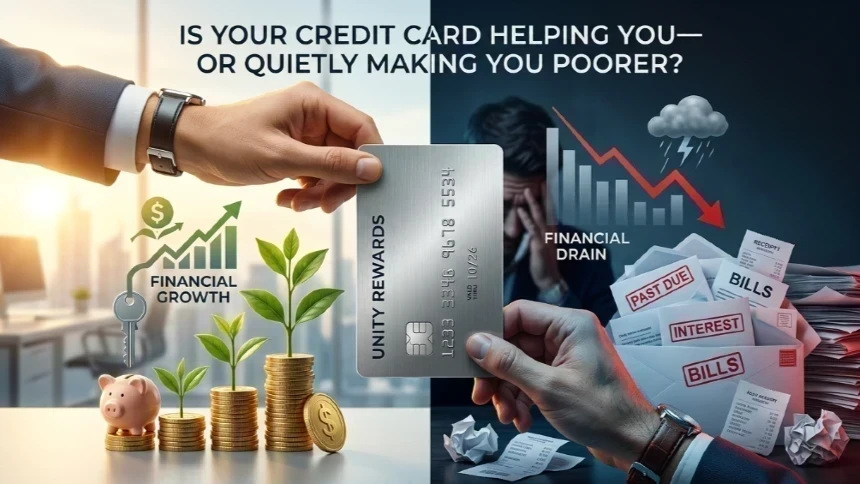



Credit cards can make you feel financially capable while quietly making you poorer. That is the uncomfortable truth many people do not discover until the balance starts following them from month to month. If you have ever opened a statement and felt your stomach drop, wondered where your paycheck went, or realized that your available credit feels more comfortable than your actual bank balance, you are not imagining the problem.
For many Americans, credit card debt is not created by one dramatic mistake. It happens quietly. A dinner here. A few online purchases there. An unexpected bill. A subscription you forgot about. Then the minimum payment arrives, and because it feels manageable, you move on.
Meanwhile, interest keeps working in the opposite direction.
The real question is not whether credit cards are good or bad. It is much more personal: Is your credit card helping you build financial stability, or is it helping you spend money you do not actually have?
Credit Cards Can Help You—But Only Under the Right Conditions
A credit card can be a genuinely useful financial tool. Used carefully, it can help establish credit history, provide purchase protections, offer rewards, and make certain expenses easier to manage. The danger begins when convenience quietly becomes dependency.
Think about the difference between these two situations. In the first, you buy a $100 item with your credit card because you already have $100 in your checking account. You pay the statement balance in full, and the card simply acts as the payment method.
In the second, you buy the same $100 item because you do not have the money right now, but your credit limit makes the purchase feel affordable. You carry the balance, make a minimum payment, and move on.
The purchase is identical. The financial consequences are completely different.
The credit limit is not income
This distinction can change everything. A $10,000 credit limit does not mean you have $10,000 available to spend. It means a lender is willing to let you borrow up to that amount under the terms of the account.
That sounds obvious, but modern life makes it surprisingly easy to forget. Shopping apps save your card information. Checkout takes seconds. Buy-now-pay-later offers appear beside products. Rewards make spending feel productive. As a result, borrowing can stop feeling like borrowing.
A simple tool such as the YNAB budgeting app can help you separate money you actually have from money a lender says you can borrow. The goal is not to obsess over every purchase. It is to make reality visible again.
Are Credit Cards Making You Poorer?
If you are asking whether credit cards are making you poorer, start with one number: how much of your credit card balance survives after you make your payment?
If you regularly carry a balance from one statement to the next, your purchases may be costing significantly more than their sticker prices. Interest can turn ordinary spending into long-term financial pressure, especially when the annual percentage rate is high.
This is where many people become trapped. The minimum payment looks small enough to handle, so the debt does not feel urgent. But a small payment can keep a balance alive for a surprisingly long time.
And while you are paying yesterday's purchases, today's expenses are still arriving.
The minimum payment can create a false sense of safety
Minimum payments are designed to keep your account current, not necessarily to help you eliminate debt quickly. That difference matters.
Imagine opening your statement and seeing that the minimum payment is only $75. You might think, “I can handle that.” But if you owe thousands of dollars and continue charging new purchases, the payment can become another permanent monthly obligation.
That is how financial fatigue develops. You are functioning. You are paying bills. You are going to work. You may even look completely fine from the outside. But mentally, you are carrying a running list of obligations that never seems to disappear.
That kind of mental fatigue is easy to underestimate. Money stress can make even simple financial decisions feel exhausting. Instead of deciding whether a purchase fits your budget, you start asking whether you can fit another payment into your month.
Interest changes the emotional equation
Interest is not emotionally exciting when you swipe a card. You do not see it at the checkout screen. You see it later, buried inside a statement.
That delay is part of what makes credit card debt so powerful.
A useful physical tool such as the Casio FC-200V financial calculator can make the cost of interest more tangible when you compare different repayment scenarios. Seeing the numbers can be uncomfortable, but clarity is often the first real step toward changing your behavior.
The Quiet Signs Your Credit Card Has Become a Problem
Credit card trouble does not always look dramatic. Sometimes it looks like a person who earns a decent income but constantly feels broke. Sometimes it looks like someone who pays every bill on time but has no money left at the end of the month.
Sometimes it looks like functioning on autopilot.
If any of these patterns sound familiar, pause before judging yourself. The point is not shame. The point is recognition.
You regularly carry a credit card balance.
You make minimum payments because larger payments feel impossible.
You use available credit for groceries or bills before payday.
You check your credit limit before deciding whether you can afford something.
You feel anxious when your statement arrives.
You pay down a card and then quickly charge it back up.
You use one credit card to manage another debt.
You avoid looking closely at your total balance.
You spend more when you have a higher available limit.
You have no clear idea how much interest you paid last year.
One sign does not automatically mean you have a serious problem. But several together deserve attention.
When spending becomes emotional
This is where the conversation becomes deeper than budgeting.
Sometimes people spend because they are bored. Sometimes they spend because they are overwhelmed. Sometimes shopping creates a brief sense of control after a difficult day. And sometimes buying something feels like a reward for surviving everything else.
Modern life normalizes emotional overload. You can be productive, responsible, employed, caring for everyone around you, and still feel mentally exhausted.
That matters because financial decisions do not happen in a vacuum. When you are tired, stressed, lonely, or mentally overloaded, convenience becomes more powerful.
A simple journal such as the Intelligent Change Five Minute Journal can be useful for noticing patterns between emotions and spending. You do not need a perfect morning routine. Even writing down what you were feeling immediately before an impulse purchase can reveal something important.
The Credit Card Test That Can Change How You Spend
Here is a simple test: if your credit card disappeared tomorrow, could you still afford your normal month?
If the answer is yes, your card may be functioning primarily as a payment tool.
If the answer is no, your credit card may have quietly become part of your income system.
That distinction is powerful because it removes the emotional language around credit cards. You are not “good” or “bad” with money. You are simply using borrowed money to fill a gap.
Once you can see that gap, you can start asking better questions.
How much do I actually spend each month?
Which expenses are necessities?
Which purchases happen when I am stressed or tired?
How much credit card interest am I paying?
What would happen if I stopped adding new charges for 30 days?
Could I redirect even a small amount toward the balance every payday?
The goal is not perfection. The goal is to interrupt autopilot.
How to Make Your Credit Card Work for You Again
If your card has become a source of financial pressure, you do not necessarily need to cancel every account immediately. Start by changing the role the card plays in your life.
1. Stop treating available credit as spending money
Your credit limit should not determine your lifestyle. Your actual cash flow should.
2. Track the full balance, not just the minimum
The minimum payment tells you what you must pay to keep the account current. Your total balance tells you what you actually owe.
3. Create a short-term spending reset
A 30-day reset can reveal how much spending is optional. Instead of making dramatic promises, temporarily remove unnecessary purchases and redirect the difference toward your highest-priority debt.
4. Build a small cash buffer
Even a modest emergency cushion can reduce the temptation to reach for a credit card when an unexpected expense appears. The first goal does not have to be thousands of dollars. Start with an amount that prevents one surprise bill from becoming another revolving balance.
5. Make your payment strategy automatic
Automation reduces decision fatigue. Schedule payments around your paydays and increase them when your budget allows. The less often you have to negotiate with yourself, the easier it becomes to stay consistent.
The Goal Is Not to Fear Credit Cards
You do not need to hate credit cards. You need to understand them.
A credit card can help build a strong credit history when used responsibly. It can make purchases more convenient. It can provide protections and rewards. But none of those benefits outweigh the cost of chronic high-interest debt.
The healthiest relationship with a credit card is surprisingly boring. You know what you can afford. You track your spending. You pay on time. You understand the interest rate. You do not confuse a credit limit with financial freedom.
Most importantly, you remain in control.
And if you have been struggling, remember this: financial burnout does not mean you are incapable of managing money. Sometimes it means you have been carrying too many decisions for too long.
You can reset.
You can look at the numbers without judging yourself.
You can stop adding new debt.
You can create a plan that fits the life you actually live instead of the perfect life you think you should have.
The Bottom Line: Is Your Credit Card Helping You or Making You Poorer?
The answer depends less on the card and more on what happens after you swipe it.
If you spend money you already have, pay your balance responsibly, understand the fees and interest, and use rewards without changing your behavior, a credit card can be useful.
If you routinely spend future income, carry balances, make minimum payments, or use credit to cope with financial and emotional pressure, the same card can quietly keep you poor.
That is the uncomfortable part: your credit card may not look like the problem because it often feels like the solution.
It gives you breathing room today. The cost arrives later.
So before your next purchase, ask yourself one question: Am I using my credit card to pay for something I can afford, or am I using it to make something I cannot afford feel affordable?
Take control before another statement arrives. Open your credit card account today, write down the full balance, interest rate, and minimum payment, and face the number you have been avoiding. Then choose one concrete action—stop new charges, increase your payment, or build your first cash buffer. You do not need to fix your entire financial life today. You need to stop letting yesterday's spending control tomorrow's money.
Clarity may feel uncomfortable at first. But once you know what is actually happening with your money, the fog begins to lift. And that is where financial progress really starts.
FAQ — Credit Cards: Are They Helping You or Making You Poorer?
1. How do I know if my credit card is actually making me poorer?
Your credit card may be hurting your finances if you regularly carry a balance, pay only the minimum, use credit for everyday expenses because your cash is gone, or feel dependent on your available credit. The biggest warning sign is when your paycheck is already committed to paying for purchases you made weeks or months ago.
2. Is paying only the minimum on a credit card really that bad?
Yes. A minimum payment can keep your account current, but it may allow the balance to remain for years while interest continues accumulating. If you keep making new purchases, you can end up paying for the same spending long after you stopped enjoying it.
3. Can using a credit card actually improve my financial situation?
Yes—if you use it as a payment tool rather than extra income. Paying your statement balance in full, staying within your budget, and keeping your utilization under control can help you build credit while avoiding unnecessary interest.
4. Why do credit cards make it so easy to overspend?
Because the pain of spending is delayed. When you use cash, you immediately see the money leave your account. With a credit card, you can receive the product today and deal with the financial consequence later. That distance can make purchases feel smaller and more affordable than they really are.
5. Should I stop using my credit cards completely if I have debt?
Not necessarily. The better question is whether using the card is helping you reduce or increase your debt. If you cannot consistently pay new purchases without adding to the balance, a temporary spending reset may be more useful than continuing to swipe while trying to pay down old debt.
6. What is the biggest credit card mistake people make?
One of the biggest mistakes is treating the credit limit like income. A $10,000 credit limit does not mean you have $10,000 to spend. It means a lender is willing to let you borrow up to that amount. Confusing borrowed money with available income can quietly destroy financial progress.
7. What should I do if my credit card debt feels overwhelming?
Start with the numbers instead of trying to solve everything at once. Write down every balance, interest rate, and minimum payment. Stop adding unnecessary charges, choose a repayment strategy, and create even a small emergency buffer. Most importantly, don't let shame keep you from looking at the problem. You cannot change a number you refuse to see.
8. Can credit card rewards make up for paying interest?
Usually, no. Rewards can be valuable when you pay your balance in full and would have made the purchase anyway. But carrying a high-interest balance simply to earn points or cash back can defeat the purpose because the interest you pay may be far greater than the rewards you receive.
9. What is the healthiest way to use a credit card?
Use it only for purchases you can already afford with money you have available. Track your spending, understand your interest rate, pay on time, and avoid allowing the balance to become a permanent part of your monthly budget. The goal is to control the card—not depend on it.
10. What is the most important question to ask before using a credit card?
Ask yourself: “If I couldn't use credit today, would I still be able to afford this?” If the answer is no, the purchase may not actually fit your finances. That single question can expose the difference between using credit for convenience and using credit because you cannot afford what you want.
Continue Building Your Financial Clarity
Now that you understand why money anxiety doesn’t go away even when you earn more, the next step is learning how to build a healthier and more peaceful relationship with your money.
You don’t need to fix everything at once.
Start with one small change — one habit, one tool, or one moment of awareness — and observe how your financial mindset begins to shift over time.
You may also like:
👉 The Truth About Money Discipline No One Talks About)
👉 You Don’t Have a Money Problem — You Have a Behavior Pattern
👉 Why You Struggle With Money Even When You Know What To Do
👉 You're Not Bad with Money: You're Repeating Patterns