





Credit card debt feels completely out of control long before the numbers become impossible to calculate. Sometimes it starts with avoiding your banking app. Sometimes it is that sudden drop in your stomach when another payment notification appears. And sometimes, you are technically functioning perfectly well—going to work, answering messages, buying groceries, taking care of everyone else—while quietly feeling like your financial life is slipping through your fingers.
That is the hidden part nobody talks about enough.
You may not actually be irresponsible. You may not be lazy. You may not even have a spending problem in the way you think you do.
You may simply be exhausted.
Modern life has normalized emotional overload to the point where many people keep functioning while carrying enormous invisible pressure. Bills, work, family responsibilities, subscriptions, emergencies, rising costs, and the constant expectation to keep up can slowly push financial decisions onto autopilot. Then one day, you look at your credit card balances and think: How did it get this bad?
If that is where you are right now, take a breath. You do not need to fix your entire financial life today. You need to stop the emotional spiral long enough to see what is actually happening.
When Credit Card Debt Feels Out of Control, Stop Trying to Fix Everything at Once
The first mistake overwhelmed people often make is trying to solve their entire debt problem in one emotional moment.
You see the balance. Panic rises. Suddenly you promise yourself that you will never spend another dollar, cancel everything, work extra hours, sell half your belongings, and become a completely different person by Monday.
Then life happens.
The plan feels impossible. You get tired. Something unexpected costs money. And the shame gets worse.
That cycle is exhausting because it confuses urgency with effectiveness.
Yes, credit card debt deserves attention. However, panic rarely creates a sustainable plan. The goal is not to become financially perfect overnight. The goal is to interrupt the pattern that allowed the debt to keep growing.
Start with a financial snapshot, not a financial transformation
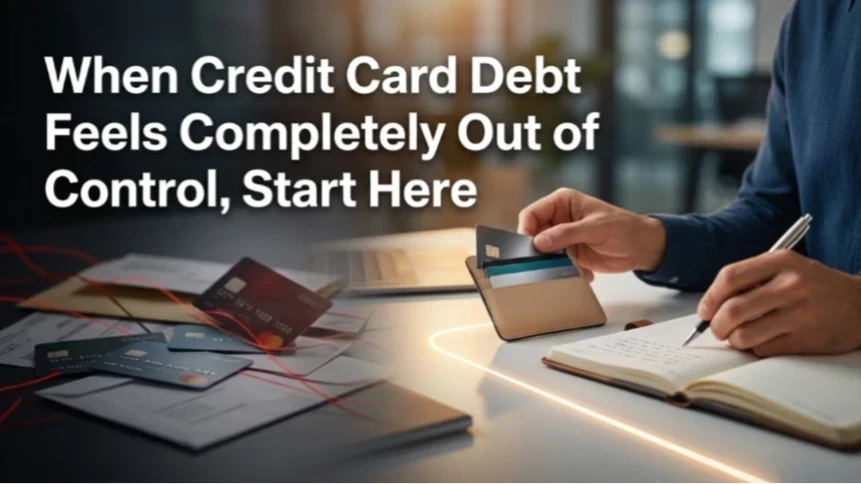
Before making big promises, write down the facts. Open every account and create a simple list containing:
The name of each credit card
The current balance
The interest rate
The minimum payment
The payment due date
Whether the account is still being used regularly
This can feel uncomfortable, especially if you have been avoiding the numbers. Nevertheless, avoiding information does not make debt smaller. It only makes uncertainty larger.
You do not need a complicated spreadsheet to begin. A simple notebook or a digital planning tool can be enough. Something like Rocket Money can also help some people organize recurring expenses and identify subscriptions that may be quietly draining their monthly cash flow.
The point is not to judge yourself. The point is to turn a vague emotional disaster into a visible financial situation.
In other words, you are replacing fear with information.
The Real Problem May Be Mental Fatigue, Not Just Credit Card Debt
There is a reason smart, capable people can suddenly feel powerless around money.
Decision fatigue is real.
Every day, you make hundreds of choices. What needs attention first? What can wait? What should you buy? Which bill gets paid now? Should you say yes to another expense? Can you afford this convenience today?
When life becomes emotionally overwhelming, the brain naturally looks for shortcuts. That is where autopilot spending can begin.
A credit card makes those shortcuts incredibly easy.
You do not necessarily think, I want more debt. Instead, you think:
I will deal with it later.
I need this right now.
This month has been unusually expensive.
I deserve something after this stressful week.
I cannot handle another problem today.
None of these thoughts make you a bad person. They make you human.
That said, repeated financial decisions made during periods of burnout can quietly create a debt problem that feels shocking when you finally slow down enough to look at it.
Functioning does not mean you are okay
Many people experiencing financial stress are still highly functional. They show up. They perform. They take care of others. They keep the household moving.
But underneath that productivity can be deep mental fatigue.
This is especially common among people carrying invisible responsibilities—planning, remembering, organizing, anticipating, and emotionally supporting everyone around them. When your brain is already overloaded, managing multiple credit cards can become one more thing you avoid simply because you have no energy left.
That is why a financial reset should also reduce mental pressure.
Consider creating a weekly money check-in that lasts no more than 20 minutes. Make it simple. Sit somewhere comfortable. Review balances, upcoming payments, and recent spending. A guided journal such as The Five Minute Journal may even help create a calming routine around reflection for people who struggle to separate financial stress from emotional stress.
The goal is not to obsess over money every day. The goal is to stop allowing money problems to grow silently in the background.
Create a Debt Plan That Your Exhausted Brain Can Actually Follow
A complicated plan may look impressive, but the best debt strategy is usually the one you can continue during a stressful month.
Start by making sure you understand your minimum payment obligations. Missing payments can create additional fees and potentially damage your credit history, so protecting your payment schedule matters.
After that, choose a simple repayment direction.
The debt avalanche approach
With the avalanche method, you generally focus extra money on the card with the highest interest rate while continuing minimum payments on the others.
This approach can reduce the amount of interest paid over time. It is mathematically efficient, which can be motivating if numbers help you stay focused.
The debt snowball approach
With the snowball method, you generally focus on paying off the smallest balance first while maintaining minimum payments elsewhere.
This may not always minimize interest costs, but it can create faster psychological wins.
And psychological wins matter.
When you feel defeated, seeing one balance disappear can create momentum. That momentum may be exactly what helps you continue.
You do not need to choose the strategy that looks smartest online. Choose the one you are most likely to follow consistently.
If calculations feel overwhelming, a tool such as YNAB can help some users create a clearer picture of where monthly income is going and how much room exists for intentional debt payments.
The key is simplicity. You should be able to explain your plan in one or two sentences.
For example: I will pay the minimum on every card and put every extra dollar toward my highest-interest balance.
That is clear. Clear plans are easier to repeat.
Stop Adding New Debt Before Trying to Make Massive Payments
This is an uncomfortable truth: aggressively paying down a credit card while continuing to add new charges can feel like running uphill on a moving treadmill.
Before focusing entirely on huge payoff goals, ask a simpler question:
Why is the balance still growing?
The answer may be obvious, but often it is not.
Maybe your income does not comfortably cover your essential expenses. Maybe irregular bills keep catching you off guard. Maybe emergencies are going onto credit cards because there is no cash buffer. Maybe subscriptions and small recurring purchases have become invisible.
Or perhaps emotional spending has become a form of temporary relief.
You do not need to shame yourself for any of these possibilities. You need to identify which one is true.
Once you know what is feeding the debt, you can address the actual problem instead of repeatedly treating the symptom.
Create friction before every new charge
You do not necessarily have to destroy every credit card or make dramatic decisions in a moment of fear. Instead, create a pause between the urge and the purchase.
Remove saved card details from shopping websites.
Wait 24 hours before nonessential purchases.
Move the physical card somewhere inconvenient.
Ask whether you would still buy the item with cash.
Write down what emotion you are feeling before purchasing.
These small barriers can be surprisingly powerful because they interrupt autopilot behavior.
Moreover, they give you something debt often steals: a moment of choice.
Look for Hidden Financial Leaks Without Punishing Yourself
When people panic about debt, they often immediately try to eliminate every enjoyable expense.
That can backfire.
A financial plan built entirely on deprivation can create resentment, and resentment often leads to rebound spending.
Instead, look for expenses that no longer provide meaningful value.
Review your recent transactions and ask:
What am I paying for automatically?
What did I forget I subscribed to?
Which purchases were stress-driven rather than intentional?
What convenience expenses could be reduced occasionally?
What costs increased without me noticing?
You may discover small opportunities. Maybe a subscription can be canceled. Maybe takeout can be reduced from four times a week to twice. Maybe insurance or service bills can be reviewed.
The goal is not to make your life miserable.
The goal is to redirect money toward something that gives you more freedom later.
Every dollar you intentionally redirect toward debt is not just a payment. It is evidence that you are no longer completely on autopilot.
If You Feel Ashamed, Remember This Truth About Credit Card Debt
Shame makes debt heavier.
It makes you hide statements. Delay conversations. Avoid asking for help. Pretend everything is fine.
And unfortunately, silence can allow financial problems to grow.
The truth is that credit card debt can happen during periods of job loss, medical expenses, caregiving, divorce, inflation, emergencies, low income, and simple financial overwhelm. Sometimes it also develops because a person never learned a practical system for managing modern expenses.
Debt is information. It is not your identity.
You are not your credit score.
You are not your balance.
You are not permanently defined by the financial decisions you made during a difficult season.
However, there is a moment when compassion must become action.
You can forgive yourself and still change the pattern.
In fact, that combination is often far more powerful than self-criticism.
Know When You Need More Support
Sometimes a personal budgeting strategy is enough to create momentum. Other times, the debt is too large relative to income, the interest costs are overwhelming, or the monthly payments are creating serious financial distress.
In those situations, consider speaking with a qualified nonprofit credit counselor or financial professional who can explain legitimate options based on your circumstances.
Be cautious with companies promising instant debt elimination, guaranteed results, or dramatic fixes that sound too good to be true. When you are emotionally overwhelmed, urgency can make aggressive marketing especially persuasive.
Slow down. Read the details. Understand fees. Ask questions.
A real solution should become clearer when examined closely, not more confusing.
Your First Financial Reset Can Happen Today
You do not need to wait until you feel motivated.
You do not need a perfect budget.
You do not need to understand every financial strategy before taking the first step.
Today, do this:
Open your credit card accounts.
Write down every balance.
Check every interest rate.
Confirm every minimum payment and due date.
Choose one simple next action.
That is enough for today.
Tomorrow, you can take the next step.
This is how control returns—not through one dramatic transformation, but through repeated moments of awareness.
You may also want to revisit our guide on how to stop living paycheck to paycheck, especially if your credit card balances are growing because monthly expenses consistently exceed available income. Another helpful next step is understanding why earning more money does not always solve financial stress.
Because sometimes the breakthrough is not simply making more.
Sometimes it is finally seeing the pattern clearly enough to change it.
Stop carrying this entire financial problem silently. Open the account you have been avoiding, look at the real number, and take one action today. You do not need to erase your debt overnight. You only need to stop letting fear make the decisions for you. Your reset can begin with the next five minutes.
The Moment You Face It Is the Moment It Starts Changing
Credit card debt feels most powerful when it is hidden in the background of your life.
When you finally look at it, something important happens.
The number may still be uncomfortable. The work may still take time. The path may not be easy.
But uncertainty begins to lose its power.
You stop imagining an endless disaster and start working with real information.
That shift matters more than most people realize.
Because financial progress does not always begin with more money. Sometimes it begins with less avoidance.
And if you have been functioning, smiling, working, caring for everyone else, and quietly feeling like something in your financial life is not okay, let this be your reminder:
You are allowed to pause.
You are allowed to look.
You are allowed to reset.
Most importantly, you are allowed to believe that being overwhelmed today does not mean you will stay overwhelmed forever.
The debt is a problem to solve. It is not the end of your story.
Strong FAQ
What should I do if my credit card debt feels completely out of control?
Stop avoiding the numbers and face the full picture. List every balance, interest rate, minimum payment, and due date. You do not need to solve everything today, but you cannot regain control of a financial problem you are afraid to look at. Clarity is the first real step toward getting out of credit card debt.
Can I get out of credit card debt even if I feel overwhelmed and exhausted?
Yes. You do not need extreme discipline or a perfect budget to start. When you are mentally exhausted, the smartest strategy is often the simplest one: protect minimum payments, stop adding unnecessary debt, choose one repayment method, and focus on consistent progress. Small actions repeated over time can create powerful financial change.
Why does my credit card debt keep growing even though I make payments?
High interest rates, new purchases, minimum payments, recurring expenses, and unexpected emergencies can keep balances growing despite regular payments. The key is to identify what is feeding the debt. Once you understand whether the problem is interest, spending, income gaps, or financial emergencies, you can build a strategy that actually addresses the cause instead of just reacting to the balance.
Continue Building Your Financial Clarity
Now that you understand why money anxiety doesn’t go away even when you earn more, the next step is learning how to build a healthier and more peaceful relationship with your money.
You don’t need to fix everything at once.
Start with one small change — one habit, one tool, or one moment of awareness — and observe how your financial mindset begins to shift over time.
You may also like:
👉 The Truth About Money Discipline No One Talks About)
👉 You Don’t Have a Money Problem — You Have a Behavior Pattern
👉 Why You Struggle With Money Even When You Know What To Do
👉 You're Not Bad with Money: You're Repeating Patterns