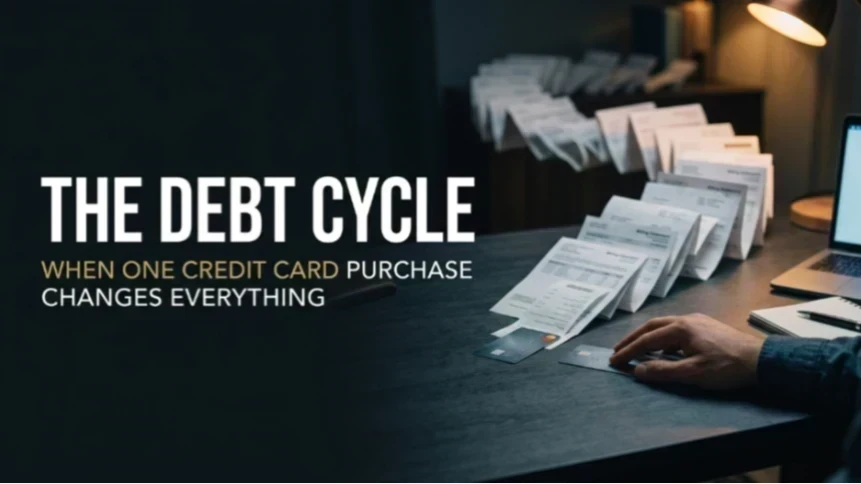
The Debt Cycle Can Start With a Purchase That Feels Completely Normal
The debt cycle rarely begins with one dramatic financial mistake. More often, it starts with something painfully ordinary: dinner after a long day, a necessary repair, groceries that cost more than expected, or a purchase you tell yourself you will pay off next month.
That is what makes credit card debt so emotionally exhausting. The purchase itself may not seem dangerous. The problem is what happens afterward.
You carry a balance. Interest appears. Another expense arrives. You use the card again. Suddenly, the money you expected to have next month is already spoken for. Then you are working, paying bills, functioning, answering messages, handling responsibilities—and quietly wondering why your finances never seem to catch up.
If that sounds familiar, it does not mean you are irresponsible. It means you may be caught inside a system that makes small decisions feel harmless while their consequences accumulate in the background.
And once you understand how the cycle works, you can start interrupting it.
How the Debt Cycle Turns One Credit Card Purchase Into a Bigger Problem
The most important thing to understand about the debt cycle is that the original purchase is often not the biggest problem. The real danger is the chain reaction that follows.
Imagine you put a $150 purchase on your credit card because you know your next paycheck is coming. You intend to pay the entire balance. Then your car needs something fixed. Your grocery bill is higher. A subscription renews. You have an exhausting week and order takeout because cooking feels impossible.
Now the card balance is no longer $150.
And this is where the psychology becomes important. Once a balance already exists, another purchase can feel less significant. The financial boundary has already been crossed, so adding another $20 or $40 does not create the same emotional resistance.
That is how a manageable expense can quietly become a pattern.
The first purchase creates a new financial reality
When you carry a credit card balance, part of your future income is already committed. You are not simply spending today's money. You are borrowing against tomorrow's flexibility.
That distinction matters because flexibility is one of the most valuable forms of financial security.
A person with $500 in available cash and no credit card balance may have more breathing room than someone with $5,000 in the bank but $6,000 in revolving credit card debt. The numbers are different, but the emotional reality is similar: the second person may feel trapped because future income already has somewhere to go.
A simple tool such as the YNAB budgeting app can help make that future commitment more visible by giving every dollar a clear job. The value is not in creating a perfect budget. It is in seeing the connection between today's choices and tomorrow's available money.
Interest makes yesterday's decision follow you
Credit card interest is especially frustrating because it can make the original purchase feel like it is getting more expensive long after you made it.
You bought something once, but if the balance remains, the cost can continue growing. Meanwhile, your next paycheck has not grown simply because the balance did.
In other words, debt can consume financial energy without creating anything new in return.
That is why paying only the minimum can sometimes feel like progress while leaving the underlying problem largely intact. You made a payment, but the balance may continue to linger for months or years depending on the interest rate, balance, and additional charges.
Why Credit Card Debt Gets Worse When You Are Mentally Exhausted
Money decisions are not made in a vacuum. They happen after work, after childcare, after errands, after difficult conversations, after trying to keep an entire household moving.
When you are experiencing mental fatigue, the easiest decision often wins.
That does not mean you lack discipline. It means your decision-making capacity is being used everywhere else.
This is one reason financially overwhelmed people can appear perfectly functional from the outside while feeling completely out of control internally. You go to work. You pay something. You respond to everyone. You keep moving.
But you are not okay.
The financial problem becomes another unfinished thought constantly running in the background.
Emotional spending is often about relief, not greed
Sometimes the purchase is not really about the item.
It is about relief.
A $25 meal can represent one less decision. A new sweater can feel like a reward after an exhausting week. A convenience purchase can feel like buying back ten minutes of your life.
That emotional connection is important because shame rarely fixes a behavior that is providing temporary relief.
If you only tell yourself to stop spending, you may be fighting the symptom instead of understanding the need underneath it.
A simple guided journal can be useful here, not as another complicated financial task, but as a place to write down what was happening emotionally before an unplanned purchase. Were you tired? Lonely? Overwhelmed? Trying to avoid another decision?
The goal is awareness, not self-judgment.
Burnout can make financial avoidance feel easier
When money becomes emotionally painful, avoidance can feel protective.
You stop opening statements immediately. You avoid checking the balance. You tell yourself you will deal with everything on the weekend. Then the weekend arrives and you are exhausted.
So you wait another week.
This creates a dangerous combination: financial stress plus financial avoidance.
The less clearly you see the numbers, the scarier they can become. The scarier they become, the more tempting it is to avoid them. And the more you avoid them, the less control you feel.
That loop can continue even when you are earning a decent income.
The Silent Moment When Debt Starts Controlling Your Paycheck
One of the clearest signs of a growing debt cycle is when your paycheck arrives and feels smaller before you even spend it.
You already know where much of it is going.
Rent. Utilities. Groceries. Minimum payments. Insurance. Transportation. Subscriptions. Credit card balances.
Then life asks for something unexpected.
And suddenly the credit card becomes the emergency fund you never had.
Debt reduces your room to absorb surprises
This is where the cycle becomes self-reinforcing.
An unexpected expense appears.
You put it on a credit card because cash is limited.
The balance increases.
Interest adds to the cost.
Your next paycheck has less flexibility.
Another unexpected expense appears.
You use credit again.
None of those individual decisions has to be reckless. Together, they can create a pattern that becomes extremely difficult to escape.
This is why building even a modest cash cushion matters. A small emergency fund does not have to solve every financial problem. Its job is to prevent every minor surprise from becoming new revolving debt.
The danger of normalizing the balance
Perhaps the most unsettling stage of the debt cycle is when the balance stops shocking you.
You see $2,000 and think, “I've had worse.”
You see $3,500 and think, “I'll handle it eventually.”
You see the minimum payment and think, “At least I'm making the payment.”
This is how debt can become part of the background of everyday life.
A simple credit card payoff calculator or spreadsheet can bring the future back into focus. Seeing how different payments affect the timeline can turn an abstract balance into something concrete and actionable.
How to Break the Debt Cycle Without Trying to Fix Your Entire Life Overnight
You do not need a perfect financial transformation to break the debt cycle. You need one interruption.
Then another.
Then another.
The most effective approach is often surprisingly simple: stop making the problem larger while creating a realistic path to make it smaller.
Start with one honest financial reset
Do not begin by creating twenty rules you cannot maintain.
Instead, write down the facts.
How much do you owe on each credit card?
What is the interest rate on each balance?
What is the minimum payment?
How much are you currently charging each month?
How much cash do you have available for emergencies?
That first look may be uncomfortable. Do it anyway.
Clarity often feels worse for ten minutes and better for weeks.
Stop treating every expense as equally urgent
Once you see the numbers, separate genuine necessities from expenses that can wait.
This is not about living an aggressively restricted life. Extreme budgeting can create its own burnout, especially when you are already mentally exhausted.
Instead, look for the expenses that repeatedly push you back onto credit.
Maybe it is delivery. Maybe it is convenience shopping. Maybe it is forgotten subscriptions. Maybe it is using the credit card whenever an unexpected bill appears because there is no cash buffer.
Find the pattern before trying to eliminate everything.
Create a system that works when motivation disappears
Motivation is unreliable. Systems are much more dependable.
Consider scheduling a short weekly money check-in. Ten or fifteen minutes can be enough to review your balance, upcoming expenses, and debt payments.
The goal is not to obsess over money. It is to prevent financial information from becoming a frightening mystery.
You can also automate payments whenever appropriate, keep a small buffer in checking, and direct extra money toward a chosen balance rather than deciding what to do with it every month.
Most importantly, give yourself permission to build a financial system that fits your actual life—not the imaginary version of your life where every meal is planned, every expense is predictable, and nobody ever needs anything unexpectedly.
The Credit Card Habit That Can Change the Direction of Your Finances
There is one mindset shift that can make a surprisingly large difference: stop asking whether you can afford the purchase today and start asking whether you want to commit future income to it.
That question creates a pause.
Maybe the answer is still yes. That is okay.
But sometimes the pause reveals something you did not notice before. You are not buying the item because you genuinely want it. You are buying convenience because you are depleted. You are buying relief because you have had no time to recover. You are buying something now because thinking about money feels harder than swiping the card.
That realization is not failure.
It is useful information.
Make the pause your new financial habit
Before using a credit card for a nonessential purchase, ask three questions:
Would I still want this if I had to pay cash today?
Will this purchase make next month's finances harder?
Am I buying the item, or am I buying relief from how I feel right now?
You will not say no every time.
You do not have to.
The purpose is to replace autopilot with awareness.
That tiny pause can be powerful because it gives your future self a voice in today's decision.
You Are Not Behind Just Because Your Finances Feel Messy
There is a difference between having a financial problem and being a financial failure.
Those are not the same thing.
You can have credit card debt and still be hardworking. You can make good money and still feel anxious. You can pay your bills and still feel like you are barely holding everything together.
Modern life has normalized an incredible amount of emotional overload. People are expected to work, manage households, remember appointments, plan meals, respond instantly, absorb unexpected expenses, and somehow make perfect financial decisions while exhausted.
That is a lot.
So if you have been functioning but not feeling okay, do not use shame as your financial strategy.
Use clarity.
Look at the balance. Understand the cycle. Find the first leak. Stop adding unnecessary debt. Build a small buffer. Make one payment that moves you forward.
Then repeat it.
Small actions can feel almost insignificant when you are staring at a large balance. But financial recovery is often built through repeated decisions that slowly give your future paycheck back to you.
The Real Goal Is Not Just Paying Off the Card
Paying off credit card debt matters, but the deeper goal is regaining financial breathing room.
Imagine opening your banking app without immediately feeling dread.
Imagine an unexpected $200 expense without automatically reaching for credit.
Imagine getting paid and knowing that most of your money belongs to your future instead of yesterday's purchases.
That is what breaking the debt cycle can create.
Not perfection.
Not a life without spending.
Just more control.
And if your financial situation feels overwhelming today, you do not need to solve everything before bedtime. Pick one balance. One spending pattern. One weekly money check-in. One small emergency buffer.
Do not let another month disappear on autopilot. Check your credit card balances today, identify what is keeping the cycle alive, and choose one action that makes your next paycheck more yours. The goal is not to become perfect with money. The goal is to stop letting yesterday's decisions quietly control tomorrow.
One credit card purchase does not have to become a permanent financial story. The cycle can be interrupted. And sometimes the first step is simply seeing the pattern clearly enough to stop repeating it.
FAQ: The Debt Cycle and Credit Card Debt
1. Can one credit card purchase really start a debt cycle?
Yes. The purchase itself may be small, but carrying the balance forward can create a chain reaction. Interest gets added, new expenses appear, and your future paycheck becomes responsible for yesterday’s spending. That is how a seemingly harmless purchase can turn into a balance that takes months or years to eliminate.
2. Why does credit card debt keep growing even when I make payments?
Because making a payment does not necessarily mean the balance is shrinking quickly. If interest is high and you are only making minimum payments—or continuing to use the card—your debt can remain for a long time. The most important question is not simply, “Am I making payments?” but “Is my overall balance actually going down?”
3. Why do I keep using my credit card even when I know I am already in debt?
Often, it is not about being irresponsible. Financial stress, burnout, and mental fatigue can make immediate relief feel more important than future consequences. When you are exhausted, putting dinner, groceries, or an unexpected expense on a card can feel like the easiest solution. Unfortunately, that temporary relief can create even more stress later.
4. What is the biggest warning sign that I am trapped in the debt cycle?
One of the biggest warning signs is using one credit card to handle expenses while trying to pay down another balance. Another is reaching payday and realizing that most of your income is already committed before the month has really started. If your credit cards are becoming your emergency fund, it is time to interrupt the pattern.
5. How can I break the credit card debt cycle if I feel completely overwhelmed?
Do not try to fix everything at once. Start with clarity. Write down every balance, interest rate, minimum payment, and due date. Then stop adding unnecessary debt and choose one realistic repayment strategy. Even a small first step can restore a sense of control when money has started to feel chaotic.
6. Should I stop using credit cards completely to get out of debt?
Not necessarily. The key issue is whether your credit card use is helping you manage money or allowing you to spend money you do not actually have. If using the card keeps increasing your balance, taking a temporary break from new charges may help you regain control while you focus on repayment.
7. Is credit card debt a sign that I am bad with money?
No. Debt is a financial situation, not a personality trait. People can end up with credit card debt because of emergencies, rising living costs, inconsistent income, emotional spending, or simply a period of life when expenses became overwhelming. The goal is not to punish yourself for what happened. The goal is to understand the pattern and change what happens next.
8. What should I do today if my credit card balance is already too high?
Start with one honest financial reset. Check the exact balance instead of avoiding it. Stop adding unnecessary charges, identify the most expensive debt, and decide how much you can realistically put toward it each month. You do not need to eliminate the entire balance today. You need to make sure today is not another day the balance gets bigger.
9. How do I prevent one unexpected expense from putting me back into debt?
Build a small cash buffer, even if you cannot afford a large emergency fund yet. The first goal is not perfection—it is creating enough breathing room that every $100 or $200 surprise does not automatically become credit card debt. Over time, that buffer can become one of your strongest defenses against the debt cycle.
10. What is the most important mindset shift when paying off credit card debt?
Stop thinking only about what you can afford today. Start asking what you are committing your future income to. That small change can make purchases look completely different. Breaking the debt cycle is not about never spending money again. It is about making sure your past decisions stop controlling your future.
Continue Building Your Financial Clarity
Now that you understand why money anxiety doesn’t go away even when you earn more, the next step is learning how to build a healthier and more peaceful relationship with your money.
You don’t need to fix everything at once.
Start with one small change — one habit, one tool, or one moment of awareness — and observe how your financial mindset begins to shift over time.
You may also like:
👉 The Truth About Money Discipline No One Talks About)
👉 You Don’t Have a Money Problem — You Have a Behavior Pattern
👉 Why You Struggle With Money Even When You Know What To Do
👉 You're Not Bad with Money: You're Repeating Patterns