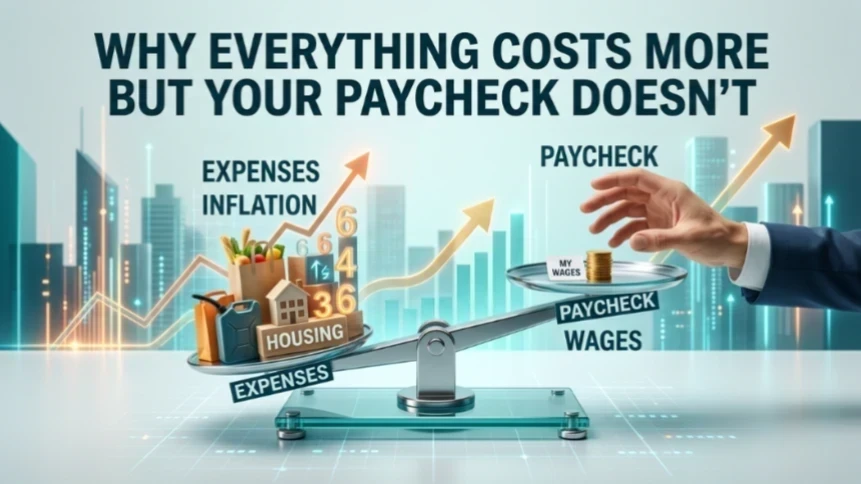









Why you’re still broke even after getting a raise can be one of the most frustrating money questions you ever ask yourself. You worked harder, your paycheck finally went up, and for a moment you expected relief. Instead, somehow, the same financial pressure is still sitting there.
Maybe your account balance disappears faster than it used to. Maybe you are paying more bills, ordering more convenience meals, replacing things that suddenly feel outdated, or simply spending without remembering exactly where the money went. You are functioning. You are working. You are paying what needs to be paid. But emotionally, something feels off.
And that feeling deserves attention.
Because sometimes getting a raise does not solve financial stress. It simply gives your existing stress more room to hide.
Why You’re Still Broke Even After Getting a Raise
The uncomfortable truth is that getting a raise does not automatically create financial progress. What matters is what happens to the money after it arrives.
This is especially easy to miss when you have been mentally exhausted for months. When you are juggling work, family responsibilities, household decisions, errands, appointments, bills, and a never-ending list of tiny obligations, money decisions can become another source of mental fatigue.
So when your income rises, convenience can feel like relief.
You upgrade the phone because the old one is annoying. You start ordering delivery because cooking feels impossible after a long day. You subscribe to another service because it makes life easier. You move into a slightly nicer place because you can finally afford it. You buy something small because you deserve one good thing after a difficult week.
None of these decisions automatically make you irresponsible.
That is important.
The problem is what happens when dozens of individually reasonable decisions quietly become a permanent monthly lifestyle.
The raise can disappear without one dramatic mistake
Most people do not lose their extra income through one enormous purchase. More often, the money gets absorbed gradually.
A slightly higher rent payment.
More frequent restaurant meals.
Additional subscriptions.
Higher insurance or transportation costs.
More shopping because the budget feels less restrictive.
More convenience spending when you are tired.
Debt payments that continue consuming part of every paycheck.
As a result, your income can look healthier on paper while your financial life feels almost exactly the same.
A simple tool such as the YNAB Budgeting App can help make this invisible movement easier to see because it gives your income specific jobs instead of letting every dollar blend into the background. The point is not to track every penny obsessively. The point is to regain visibility.
The Hidden Cost of Mental Overload
Mental fatigue can change the way you spend money. When your brain has been making decisions all day, even simple financial choices can feel exhausting.
Think about the end of an ordinary workday. You have answered messages, handled problems, completed tasks, made decisions, and perhaps spent hours worrying about things that other people never even notice. Then you remember dinner still needs to happen.
You could cook.
You could clean.
You could plan tomorrow.
Or you could tap a few buttons and have dinner arrive at your door.
When you are exhausted, the immediate relief can feel more valuable than the future cost.
This is where financial stress becomes deeply emotional. The purchase is not always about the item. Sometimes it is about escaping one more decision.
Functioning does not always mean you are okay
Modern life has normalized a strange kind of emotional overload. You can look completely responsible from the outside while quietly running on empty.
You go to work. You answer emails. You remember birthdays. You pay bills. You show up for people. You keep the household moving.
And yet you may lie in bed wondering why you still cannot get ahead.
That disconnect can create shame. You start thinking, I make more money now. Why can't I get this together?
But shame rarely produces clarity. It usually produces avoidance.
Instead, try asking a more useful question: What is my money currently doing for me?
Is it buying convenience? Security? Comfort? Status? Escape? Time? Relief?
The answer can reveal more than a traditional budget ever will.
A simple Five Minute Journal or similar journaling routine can also create a small pause between emotion and action. You do not need a complicated financial diary. Even writing down what you were feeling immediately before an unexpected purchase can reveal patterns you could not see before.
Your Raise May Have Increased Your Lifestyle Before Your Security
Lifestyle inflation is one of the biggest reasons people can remain financially stuck after their income increases.
The concept is simple: as income rises, spending rises too.
Sometimes this happens intentionally. You finally have enough money to improve your life, and you choose to do so. Other times it happens almost invisibly.
A $75 increase here. A $120 increase there. A new subscription. A nicer grocery routine. More frequent rideshares. A larger apartment. More expensive vacations. Better services.
Individually, none of these changes may seem significant.
Together, they can consume the raise.
The danger is not enjoying your money
You do not need to live like you are still earning your old salary forever.
Money is supposed to improve your life. There is nothing wrong with using some of a raise for comfort, experiences, or things that genuinely matter to you.
The important distinction is whether your spending is intentional or simply automatic.
Before upgrading something, ask yourself:
Will this meaningfully improve my life?
Is this a one-time expense or a new recurring commitment?
Am I choosing this because I want it or because I am exhausted?
Will I still value it six months from now?
What would happen if I kept this portion of my raise instead?
That last question is powerful because it creates a pause.
For example, if your raise gives you an additional $300 per month, you do not have to save all $300. You could decide that $150 improves your current life and $150 strengthens your future.
The exact amount matters less than creating a deliberate boundary.
Even something as simple as a comfortable Hatch Restore sleep routine can fit into this broader idea of reducing decision fatigue: when you protect your rest and create calmer routines, you may have more mental space for thoughtful decisions instead of constantly operating on autopilot.
The Money Leak May Be Smaller Than You Think
You may not have an income problem. You may have a visibility problem.
This distinction can completely change the conversation.
If you believe you simply do not make enough money, every financial solution seems to require earning more. Another promotion. Another side hustle. Another source of income.
But if your income has already increased and the pressure remains, it is worth examining what changed around the raise.
Look for recurring expenses first
Recurring expenses deserve special attention because they repeat without asking for permission every month.
Open your bank and credit card statements and search for anything that appears repeatedly. Do not judge the expense yet. Just collect the evidence.
List your fixed monthly bills.
List subscriptions and memberships.
Review delivery, rideshare, and convenience spending.
Check debt payments and interest charges.
Compare your current housing and transportation costs with what you paid before the raise.
Identify expenses that became normal only after your income increased.
That final category can be surprisingly revealing.
You are not looking for a villain. You are looking for a pattern.
Ask what your raise actually changed
Take your current monthly take-home income and compare it with your income before the raise.
Then ask where the difference went.
If the answer is unclear, that is useful information.
You do not need to immediately cut everything. First, make the invisible visible.
For some people, the biggest surprise is how much of the additional income is going toward recurring commitments. For others, it is emotional spending, debt, convenience, or simply a higher baseline cost of living.
Once you can name the pattern, you can make a different decision.
What to Do With Your Next Raise
The easiest time to protect a raise is before you get used to it.
That is why your next raise should have a plan before the first larger paycheck arrives.
You can divide the increase into clear purposes. One portion can improve your current lifestyle. Another can build savings. Another can accelerate debt repayment or support a specific financial goal.
The percentages do not need to be perfect.
What matters is that the decision happens before the extra money becomes psychologically available for everything.
Create a raise rule
A simple personal rule could be: Whenever my income increases, part of the increase automatically goes toward my future before I change my lifestyle.
This creates a protective barrier around your progress.
For example, imagine your take-home pay increases by $400 per month. Instead of mentally treating the full $400 as available spending money, you might automatically redirect a portion to savings and use the rest intentionally.
Over time, this can change the emotional experience of earning more. Your raise stops being money that disappears and becomes evidence that your financial position is actually improving.
You Are Allowed to Want More Than Survival
Being financially responsible does not mean denying yourself everything.
If you have spent years worrying about bills, living paycheck to paycheck, or feeling guilty about every purchase, a raise can create a complicated emotional reaction.
Part of you wants to finally enjoy life.
Another part is terrified that the money will disappear.
That conflict can lead to an exhausting cycle: work harder, earn more, spend more, worry more, then promise yourself that next month will be different.
You do not need another round of self-punishment.
You need clarity.
Financial progress can include a better emergency fund, less credit card debt, more breathing room, a calmer home, a planned vacation, or simply the ability to look at your checking account without your stomach tightening.
Those things count.
Give your money a job that supports your real life
Instead of asking only, Can I afford this? ask, What am I trying to make easier, safer, or better?
That question connects your spending to your values.
Maybe you want fewer stressful mornings. Maybe you want to stop relying on credit cards. Maybe you want three months of expenses saved. Maybe you want to sleep better because you know an unexpected bill will not immediately become a crisis.
Your goals do not have to look impressive to anyone else.
They only need to matter to you.
The Reset: What to Do This Week
You do not need a perfect budget to start changing what happens to your money. You need one honest hour.
Choose a quiet moment and look at the last 30 days of spending. Notice what feels necessary, what feels valuable, and what feels like the financial equivalent of leaving a faucet slightly open.
Then choose one change.
Cancel one recurring expense you no longer value.
Automate part of your paycheck into savings.
Set a weekly spending check-in.
Choose one category where convenience spending has become automatic.
Put a specific portion of future raises toward a financial goal.
Write down the emotional trigger behind your most common impulse purchases.
Do not underestimate a small reset.
The goal is not to become a completely different person by next Tuesday. The goal is to stop living on financial autopilot.
Once you see where the money is going, you can decide what deserves to stay.
Getting a Raise Should Change More Than Your Paycheck
A raise can increase your income without increasing your sense of security. That is why the question is not simply whether you earn enough.
The deeper question is whether your money is creating the life you thought the raise would create.
If you are still stressed after earning more, that does not automatically mean you failed. It may mean your lifestyle changed, your responsibilities increased, your debt is absorbing more income, or your mental load has made intentional financial decisions harder.
And once you recognize that, the situation becomes much less mysterious.
You can examine the recurring expenses. You can notice the emotional spending. You can protect part of future raises. You can create a financial routine that works even when you are tired.
Most importantly, you can stop confusing exhaustion with failure.
Take the next 15 minutes and look at what changed after your last raise. Find one recurring expense, one spending pattern, and one amount you can redirect toward your future. Do it today, while the realization is fresh. Your next raise should not simply make your life more expensive. It should give you more room to breathe.
The goal is not to prove that you can live with less. The goal is to make sure that earning more actually gives you something you can feel: more choice, more stability, and more clarity.
Continue Building Your Financial Clarity
Now that you understand why money anxiety doesn’t go away even when you earn more, the next step is learning how to build a healthier and more peaceful relationship with your money.
You don’t need to fix everything at once.
Start with one small change — one habit, one tool, or one moment of awareness — and observe how your financial mindset begins to shift over time.
You may also like:
👉 The Truth About Money Discipline No One Talks About)
👉 You Don’t Have a Money Problem — You Have a Behavior Pattern
👉 Why You Struggle With Money Even When You Know What To Do
👉 You're Not Bad with Money: You're Repeating Patterns