





Everything costs more but your paycheck doesn’t. And if you have been quietly wondering why your money seems to disappear faster than it used to, you are not imagining the pressure. You can be working, paying the bills, buying only what you need, and still feel like something is fundamentally off.
Maybe you are functioning. You get up, go to work, answer the messages, make dinner, handle the bills, remember everyone's appointments, and keep moving. But underneath all of that, you are tired. Not just physically tired. Mentally tired from constantly calculating.
You check the grocery total twice. You hesitate before filling the gas tank. You see a utility bill and immediately start rearranging the rest of the month in your head. Then an ordinary expense appears, and suddenly the entire budget feels fragile.
This is one of the most frustrating parts of modern money stress: you can be doing everything you are supposed to do and still feel behind.
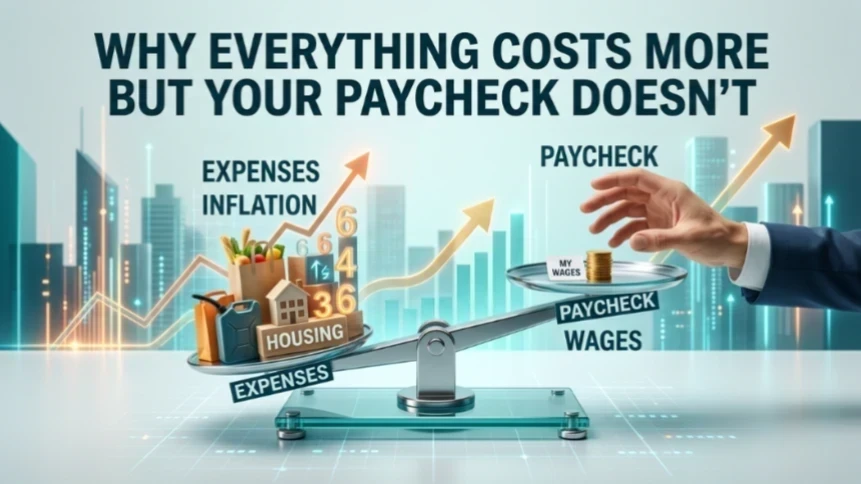
Why Everything Costs More but Your Paycheck Doesn’t
The simplest explanation is that your income and your everyday expenses do not always move at the same speed. When prices rise, your paycheck may technically remain the same while its purchasing power changes. In other words, the number on your paycheck can look familiar while the amount of life that paycheck can actually buy becomes smaller.
That difference is easy to underestimate because it rarely arrives as one dramatic financial event. Instead, it shows up everywhere.
Groceries cost more than you remember.
Housing takes a larger share of your income.
Insurance premiums and transportation expenses can add pressure.
Utilities and household necessities become harder to predict.
Services you once considered inexpensive can quietly become meaningful monthly expenses.
One extra dollar here and another few dollars there may not feel significant in isolation. But your budget does not experience those expenses in isolation. It experiences them all at once.
That is why someone can say, “I have not changed my lifestyle that much,” while simultaneously feeling financially squeezed. The lifestyle may look similar from the outside, but maintaining it can require considerably more money.
The silent math behind the feeling
Imagine that several years ago you could buy your usual groceries, pay your bills, fill your car, and still have a comfortable amount left over. Today, you make similar choices, but the leftover amount seems to vanish.
The emotional conclusion is often, “I must be doing something wrong.” But that conclusion can be too simple.
Your first job is not to judge yourself. It is to understand the math.
A simple tool such as YNAB can help you see where your income is being assigned and which categories are putting the most pressure on your monthly cash flow. The value is not in creating a perfect budget. It is in making the invisible visible.
The Emotional Cost of a Higher Cost of Living
Rising expenses do not only affect your bank account. They can occupy space in your mind all day long.
You might be folding laundry while thinking about a credit card payment. You might be driving to work while calculating whether you can afford a repair. You might be trying to fall asleep while remembering a bill you have not paid yet.
This is where money stress becomes more than a financial issue. It becomes a mental-load issue.
Mental fatigue happens when your brain is forced to make too many decisions for too long. When money feels tight, even ordinary choices can become calculations. Do I buy this now? Can I wait? Should I move money from savings? Is there enough until payday? Did I forget something?
And when you are already emotionally overwhelmed, decision-making becomes even harder.
Functioning but not okay
There is a particular kind of exhaustion that is easy to miss because you are still getting everything done.
You are working. You are answering emails. You are taking care of the house. You are showing up for your family. You are paying what needs to be paid. From the outside, everything appears normal.
But internally, you may feel like you are constantly one unexpected expense away from losing your balance.
That experience can create a strange form of silent burnout. You are not necessarily in a financial crisis. You are simply tired of having to think about money all the time.
Moreover, modern life often normalizes this emotional overload. Being busy is treated as normal. Being exhausted is treated as normal. Constantly juggling responsibilities is treated as normal. Even financial anxiety can become something people quietly carry without discussing.
That does not mean you have failed. It means the pressure deserves your attention.
A small comfort ritual can sometimes help create separation between financial worries and the rest of your evening. Something as simple as Calm or another sleep-focused app can become part of a nightly routine where you deliberately stop solving tomorrow's money problems at bedtime.
The Problem May Not Be That You Spend Too Much
One of the most damaging assumptions in personal finance is that every money problem must be caused by unnecessary spending.
Sometimes spending is part of the problem. But sometimes the deeper issue is that the essential cost of maintaining your life has changed.
If housing, transportation, food, insurance, utilities, and other recurring obligations consume more of your income, cutting a few small pleasures may provide only limited relief.
This matters because endless restriction can create its own emotional cost.
You skip the coffee. Then you skip dinner out. Then you stop buying things you genuinely need. You keep telling yourself that you just have to be more disciplined. Yet the feeling of financial pressure remains.
Eventually, you may become so mentally exhausted that you make an impulsive purchase simply because you want one moment of relief.
That cycle can look like this:
Money feels tight.
You respond by becoming extremely restrictive.
The restriction creates frustration and decision fatigue.
You seek a small emotional escape.
You spend more than planned.
You feel guilty and become even more restrictive.
The answer is not necessarily to become stricter. Sometimes it is to become more strategic.
Look at the expenses that actually move the needle
Start with your largest recurring categories. Housing, transportation, insurance, debt payments, childcare, utilities, and groceries can have a much greater effect on your financial breathing room than a handful of small purchases.
This does not mean every large expense should be eliminated. It means you should know which expenses deserve your attention.
If one recurring bill costs hundreds of dollars every month, understanding that bill may be more useful than spending hours tracking every tiny purchase.
A simple financial journal can also help. With something like OneNote, you can create a private weekly money page and write down what felt financially heavy, what surprised you, and what needs attention next. The goal is clarity, not perfection.
Why Your Paycheck Can Feel Smaller Even When It Hasn't Changed
Your paycheck is only one side of the equation. The other side is what that paycheck has to accomplish.
When more of your income is committed before the month even begins, your available money feels smaller. This is why two people earning the same amount can experience very different levels of financial pressure.
The issue is not simply how much comes in. It is how much remains after the obligations that keep daily life functioning.
And this is where the emotional experience becomes especially powerful.
When your margin becomes smaller, every unexpected expense feels larger.
A $100 repair may once have been annoying. Now it may require moving money from another category. A grocery bill that is slightly higher than expected may force you to reconsider what happens later in the month. A subscription you forgot about suddenly feels like proof that you are losing control.
As a result, your brain starts treating ordinary financial events as threats.
The autopilot problem
When people are overwhelmed, they often operate on autopilot. You renew the subscription because it is easier than deciding whether to cancel it. You order food because you are too exhausted to think about dinner. You postpone reviewing the insurance bill because you do not have the emotional energy for another financial task.
None of these choices automatically make you irresponsible.
They reveal something important: financial behavior is connected to energy.
If your life is already demanding everything from you, the solution cannot depend entirely on having unlimited motivation at the end of every day.
That is why simple systems matter. Automating savings, reviewing recurring expenses once a month, keeping a short list of upcoming bills, and creating a weekly money check-in can reduce the number of financial decisions you have to make when you are exhausted.
The Reset: Stop Trying to Fix Everything at Once
If everything feels more expensive right now, you do not need to rebuild your entire financial life tonight.
Start with clarity.
Open your bank account and look without judging yourself. Write down your current income. Then list your largest recurring expenses. Finally, identify the expenses that fluctuate the most.
Ask yourself three questions:
What expense creates the most pressure every month?
What expense keeps surprising me?
What financial decision would make next month feel slightly easier?
Notice that none of those questions asks, “What can I punish myself for buying?”
The goal is to understand your current reality well enough to make one useful change.
Give your money a place to breathe
Even a small amount of financial margin can change how a month feels. If you can create a modest buffer, it may reduce the emotional intensity of every unexpected expense.
That buffer does not have to be enormous to matter. The first goal can simply be creating a little space between what happens and how urgently you have to react.
Moreover, clarity itself can feel like relief. Knowing what is coming is different from constantly fearing that something is coming.
This is why a monthly money reset can be so powerful. Once a month, review recurring charges, upcoming bills, savings progress, and one expense you want to understand better. Keep it short. Keep it realistic. Most importantly, make it repeatable.
You Are Not Imagining the Pressure
If you have been thinking, “I make money, so why do I still feel like I cannot get ahead?” pause before turning that frustration against yourself.
The experience of financial pressure can come from a complicated combination of income, prices, recurring obligations, debt, household responsibilities, and mental load.
And for people already carrying a large share of the invisible work of everyday life, money decisions can become one more responsibility layered onto an already crowded mind.
The truth is not that you need to become perfect with money.
The truth is that you need a clearer picture of what your money is being asked to do.
Once you can see that picture, you can start separating what you can control from what you cannot. You can decide which expenses deserve attention, which habits need adjusting, and where a small change could create more breathing room.
That shift may sound modest, but it can change the entire emotional relationship you have with your finances.
You do not need to solve your whole financial life in one night. You need to stop carrying the whole problem around in your head.
Take 15 minutes today and face the numbers without judgment. Look at your income, your biggest recurring expenses, and what is actually left. Write down the one change that could make next month easier. Do not wait until you feel completely ready. Clarity starts when you finally give your money your full attention.
Everything may cost more than it used to. Your paycheck may not have changed enough to compensate. But that does not mean you are powerless, and it does not mean your financial story is permanently stuck.
Start with the truth. Start with the numbers. Start with one small reset.
Sometimes the first sign that things are getting better is not having more money. It is finally knowing where your money is going.
FAQ — Why Everything Costs More but Your Paycheck Doesn’t
Why does everything cost more when my paycheck hasn’t changed?
Because your income may not be keeping pace with the rising cost of everyday essentials. Even if your paycheck looks exactly the same, groceries, housing, transportation, insurance, utilities, and other recurring expenses can take a larger share of it. The result is less money left over, which can make your paycheck feel smaller even when the number itself has not changed.
Why do I feel broke even though I’m still earning money?
Feeling financially stretched does not necessarily mean you are spending irresponsibly. When more of your income is committed to essential expenses, your financial margin becomes smaller. That means an ordinary surprise—like a higher grocery bill, car repair, or unexpected fee—can create much more stress than it once did.
Can the rising cost of living cause mental fatigue?
Absolutely. Constantly calculating whether you can afford something, checking your bank balance, worrying about upcoming bills, and adjusting your spending can create ongoing mental pressure. Over time, money decisions can become exhausting, especially when you are already managing work, family responsibilities, household tasks, and other demands.
Why does saving money feel harder even when I’m trying?
Saving becomes harder when your essential expenses consume more of your available income. You may be cutting unnecessary purchases and still struggle to build savings because there simply is not as much financial breathing room. Instead of assuming you lack discipline, look at your largest recurring expenses and how much income remains after covering necessities.
Should I stop buying small things like coffee and takeout?
Small purchases can matter, but they are not always the biggest reason you feel financially squeezed. If a large recurring expense is consuming hundreds or thousands of dollars each month, focusing exclusively on small purchases may distract you from the expenses that have the greatest impact on your budget. The goal is not maximum restriction—it is strategic spending.
What should I do if my paycheck no longer feels like enough?
Start with a financial reset rather than trying to change everything at once. Review your income, list your largest recurring expenses, identify bills that have increased, and determine what is actually left after necessities. Then choose one realistic adjustment that could create more breathing room next month.
Why does money stress make everyday decisions feel harder?
Financial stress increases the number of decisions your brain has to process. When you are constantly thinking about bills, groceries, savings, debt, and unexpected expenses, even simple choices can feel overwhelming. This mental fatigue can also make autopilot spending more likely because you are looking for the easiest decision when your energy is already depleted.
How can I stop feeling like I’m constantly behind financially?
Begin by replacing uncertainty with visibility. Know what comes in, what goes out, which expenses are fixed, and which ones are flexible. A short weekly money check-in can help you stay connected to your finances without turning budgeting into an all-day task. Financial clarity often comes before financial progress.
Continue Building Your Financial Clarity
Now that you understand why money anxiety doesn’t go away even when you earn more, the next step is learning how to build a healthier and more peaceful relationship with your money.
You don’t need to fix everything at once.
Start with one small change — one habit, one tool, or one moment of awareness — and observe how your financial mindset begins to shift over time.
You may also like:
👉 The Truth About Money Discipline No One Talks About)
👉 You Don’t Have a Money Problem — You Have a Behavior Pattern
👉 Why You Struggle With Money Even When You Know What To Do
👉 You're Not Bad with Money: You're Repeating Patterns